
Union County VINELink Coverage
Ohio VINE is a custody status and notification service for records supplied by participating agencies. In Union County, adult county detainees are housed at Tri-County Regional Jail in Mechanicsburg. That regional custodian is the local record to seek. A person committed to an Ohio prison belongs under the Ohio Department of Rehabilitation and Correction, or ODRC, stream. VINELink can show a stated custody status, the contributing facility or agency, and event information that the source sent. It is useful for watching one known person. It is not a complete arrest archive or a substitute for the signed release record.
Custody type sets the boundary. A county-jail event can mean release, transfer, escape, return after escape, or death, depending on what Tri-County reports. ODRC supplies a separate state-prison stream. The Federal Bureau of Prisons and ICE are not covered by Ohio VINELink. A person who leaves Tri-County for ODRC, another county, or a federal custodian has left the local booking but has not necessarily entered the community.
The Ohio VINELink entry screen is the official starting point for a Union County release check.
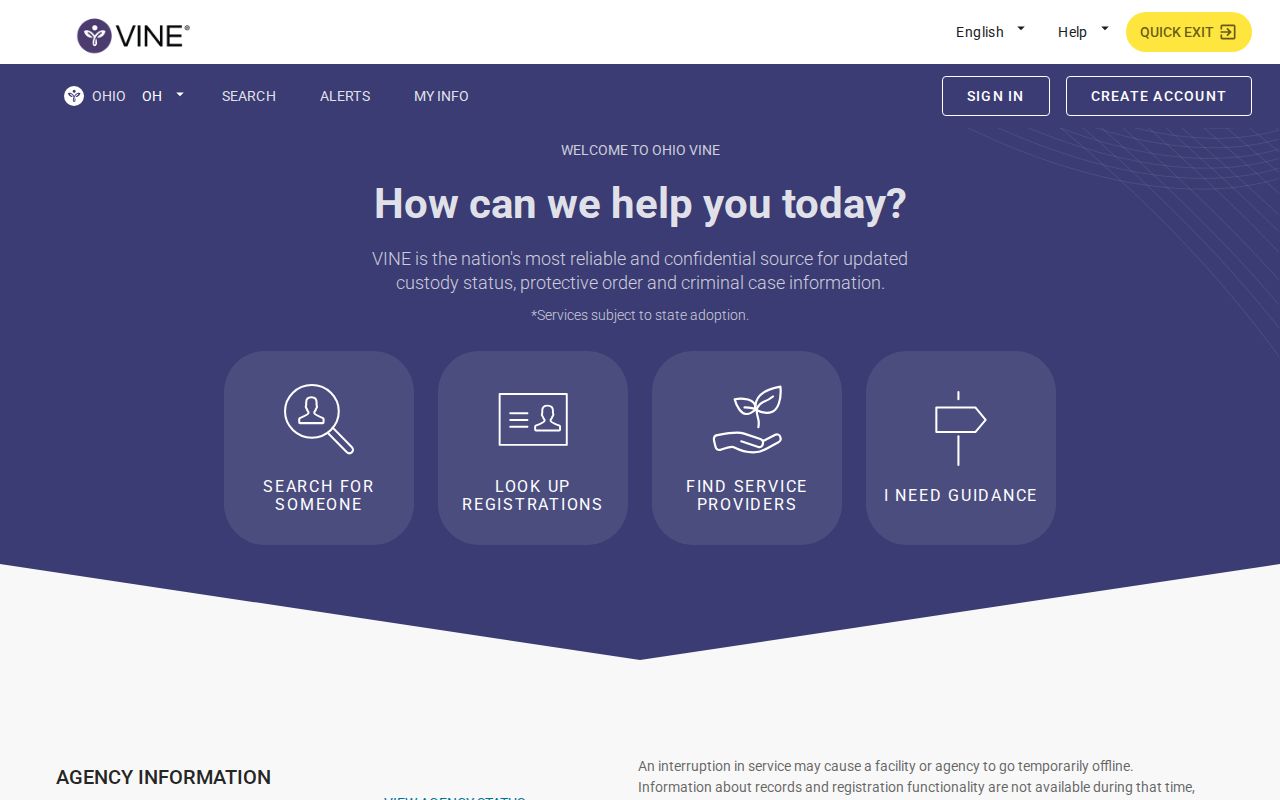
The state screen leads to the person search and notification controls, but each result still depends on data from the named agency.
Search Union County VINELink
Start with enough data to separate people who share a name. A legal first and last name is useful. An agency ID is better when it is known. Date of birth or another displayed identifier should be compared before any status is attributed to a person. Search spelling variants if the first attempt fails, then change the selected custodian rather than treating a blank result as proof of release.
- Open Ohio VINELink and choose the custody status search.
- Enter the person's name or available ID. Begin with the least restrictive accurate fields.
- Select or refine the agency. Seek Tri-County or its participating local record for Union County jail custody and ODRC for state prison custody.
- Open the likely match and compare the date of birth, ID, agency, and other shown identifiers.
- Read the event and its source together. Search the other custodian when a transfer is plausible.
Several negative results can occur without a community release. The name may be misspelled, the feed may be late, the person may have moved to another agency, or the selected system may not participate for that event. For a broader named-person path across jail, court, and ODRC records, use the Union County released inmate search.
Union County VINE Release Fields
A matched VINELink record reports what the contributing agency has sent. Field labels can change, and not every agency supplies the same set. The key task is to distinguish identity fields from custody events. A displayed release event is evidence that the named contributor closed or changed its custody status. It does not prove that no other agency took custody at once.
| Field | What it establishes |
|---|---|
| Name or person ID | Helps distinguish the matched person; compare all available identifiers. |
| Custody status | Reports the current status supplied by that contributor, such as in custody or released. |
| Facility or agency | Identifies which custodian supplied the record and defines the result's scope. |
| Event information | Shows the reported custody change and available update or event timing. |
| Notification options | Lists the event types and contact channels offered for that record. |
For a local release, compare the VINE event with the Tri-County jail register. Ohio law requires that register to state the date and manner of discharge. The manner matters because it can distinguish community discharge from delivery to another custodian. For prison custody, compare VINELink with the ODRC Offender Search status, release detail, and supervision fields.
Note: A VINE release result is a downstream agency event, while the jail register or ODRC release record documents the controlling discharge.
Set Union County Release Alerts
Registration begins on the correct person's record. The available choices can include release and other custody changes, with phone, text, or email offered as the interface permits. Each destination must be entered and verified. Telephone registration may ask for a personal identification number, or PIN, so the recipient can acknowledge a call. That PIN belongs to the alert registration. It is not the incarcerated person's ID.
- Open the verified person record and select the notification control.
- Choose each offered event that matters, including release or custody change when available.
- Select phone, text, or email and enter the correct contact destination.
- Create or provide the requested telephone PIN if the Ohio flow asks for one.
- Finish confirmation by code, link, or PIN, then save the registration details.
- Return later to confirm the subscription and keep contact information current.
Register each contact channel as directed. Tri-County's local instructions say a separate telephone registration is needed for each number. Never publish the PIN or treat it as a general code. If a call arrives, use the chosen PIN to acknowledge it according to the prompt.
Tri-County describes VINE as free and anonymous and publishes 1-800-770-0192 as the telephone registration route. Have the person's name or ID and the notification telephone number ready. The regional instructions call for a four-digit PIN. Older Ohio program material says email registration does not use the telephone PIN, while current screen wording can differ. Follow the live prompt for each selected channel. Phone, email, text, and TTY may be offered through the Ohio program, but availability should be confirmed on the matched record.
Notification is most useful before an expected event. Save the agency name, record identifier, registration channel, and confirmation details. If an expected call does not arrive, revisit the matched record and contact the custodian. VINE warns users not to rely on the service alone. Direct agency confirmation remains essential for safety planning and an accurate account of custody.
Read Union County Custody Alerts
An alert names an event, but the label must be read in the context of its contributing agency. Tri-County's local VINE information lists general release, transfer, escape, return after escape, and death among the events it can report. These events have very different meanings. A transfer closes custody at one site and continues it at another. An escape is not a lawful release. A return event means custody resumed after an escape. Death is also not a community discharge.
| Alert type | Next confirmation |
|---|---|
| General release | Ask for the date and manner of discharge, then check the court docket when an order or bond is involved. |
| Transfer | Search the named receiving agency, ODRC, another county jail, BOP, or ICE as the facts require. |
| Escape | Treat the person as outside authorized custody, not discharged, and follow official safety information. |
| Return after escape | Confirm the current facility because the person has reentered custody. |
| Death | Use the responsible agency's official record; do not describe the event as release. |
ODRC results need a similar close read. “Incarcerated” means state prison custody. “APA Supervision” can cover parole, post-release control, or a violator-at-large status. Parole is conditional release from prison under supervision. Post-release control is a supervision term imposed after qualifying prison sentences. A violator at large is recorded as outside compliance with supervision, not proven to be in jail. “Released” is an ODRC historical search category, while “Judicial Release” means a court shortened prison confinement under Ohio law.
Time also matters. Compare the alert event time, the live jail roster update, and the ODRC record before resolving a conflict. A court order may authorize release while jail processing is still underway. VINE may report after the jail transaction. ODRC may not yet show a new reception after transfer. State only the narrow fact each source proves until the records agree.
Regional Union County VINE Records
Union County has no standalone county jail roster because its adult detainees are housed by Tri-County Regional Jail. The county's regional jail explanation confirms that relationship. The Tri-County roster is limited to current custody. A local VINELink check must therefore follow the regional custodian, not a made-up Union County jail agency. This is a key local distinction. It prevents a correct result from being missed merely because the search began with the county name alone.
A transfer between Tri-County and ODRC can close the local custody record and open a state record. Such a change may trigger a local event without community release. Search ODRC next when the committing court is Union County Common Pleas and prison transfer is plausible. A receiving-agency match confirms continued custody, even though Tri-County no longer lists the person.
The Tri-County victim-notification page documents the regional VINE layer, including release, transfer, escape, return after escape, and death events.
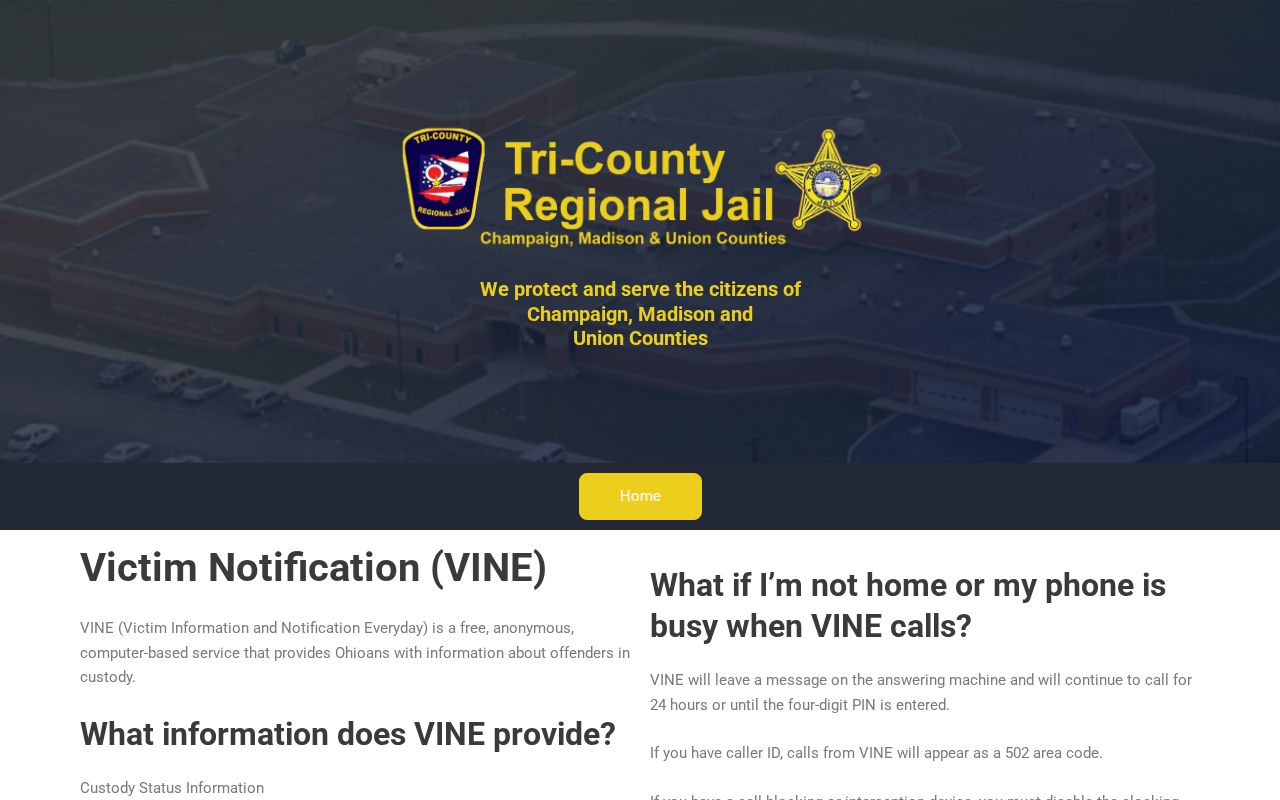
The local instructions reinforce why event type and custodian must be read together before describing someone as released to the community.
Confirm Union County VINE Releases
VINE can be delayed or missed because of agency feed timing, carrier issues, transfer timing, or data entered by the registrant. An absent call does not prove continued custody. A received call does not by itself reveal whether the person entered the community. Treat the alert as a prompt to check the source.
Call Tri-County Regional Jail at 937-834-5000 for the current local position. For a state record, use the ODRC Offender Search and read the full qualifier, dates, and supervision detail. A status such as APA Supervision can mean the person is outside prison but still under Ohio Adult Parole Authority control. Released is a historical state category, not a county-jail record.
For the local discharge proof, use the Union County Sheriff's Office public-record channels and ask for the jail-register date and manner of discharge. The Sheriff may route the request to Tri-County as the jail operator. A custodian referral does not prove that the record is absent.
Federal paths stay separate. The BOP Inmate Locator covers federal prisoners, and the ICE locator covers civil immigration detention. Neither is replaced by VINELink. A local roster absence, no VINE match, and no ODRC match are three limited negative results. None establishes a community discharge without an authoritative release or transfer entry.