
ODRC Releases for Union County
The Ohio Department of Rehabilitation and Correction operates the state prison system. It is not Union County’s local jail. A felony commitment from Union County Common Pleas Court can move a person from Tri-County Regional Jail into any institution assigned by ODRC. That movement closes one local custody stage but is a transfer, not a community release. The state record becomes the right place to follow incarceration, sentence data, parole eligibility, and later supervision.
An ODRC departure can lead to several outcomes. A person may reach sentence expiration, receive judicial release from the sentencing court, be released to Adult Parole Authority supervision, enter transitional control, or transfer to another authority. “APA Supervision” usually means the person is outside prison but remains under parole or post-release control. “Released” is a public historical status category. The full qualifier and release detail explain more than either word alone.
The final state-prison event should be confirmed through ODRC. A Union County court entry can explain judicial action, but it may precede physical processing. If another agency takes custody, that receiving agency completes the record chain.
Search ODRC Union County Releases
The ODRC Offender Search is the main public lookup for Ohio state prisoners, people under Department supervision, and judicial releases. It is not a complete record of every arrest or every stay at Tri-County. Start with a DRC number when available. ODRC uses an A, R, or W prefix with six digits, instructs searchers to remove hyphens, and may require a leading zero.
- Enter the DRC number, or begin with the last name and then add the first name. Broad criteria can work better than filling every field.
- Use County of Commitment as Union only when the conviction came from that county. Do not substitute residential county or institution location.
- Run the Incarcerated, Released, APA Supervision, and Violators at Large status views as the facts require.
- Open the detail. Compare identity, photograph, offense, sentence, county, institution, dates, and supervision information.
- Read the complete status qualifier and “Parole or Release Detail.” A short label should not be interpreted alone.
- Ask ODRC for the releasable underlying record when a public field is missing or conflicts with the court judgment.
The official search page shows the available status and county filters. Its ODRC search form illustrates why commitment county, residential county, and status are separate fields.
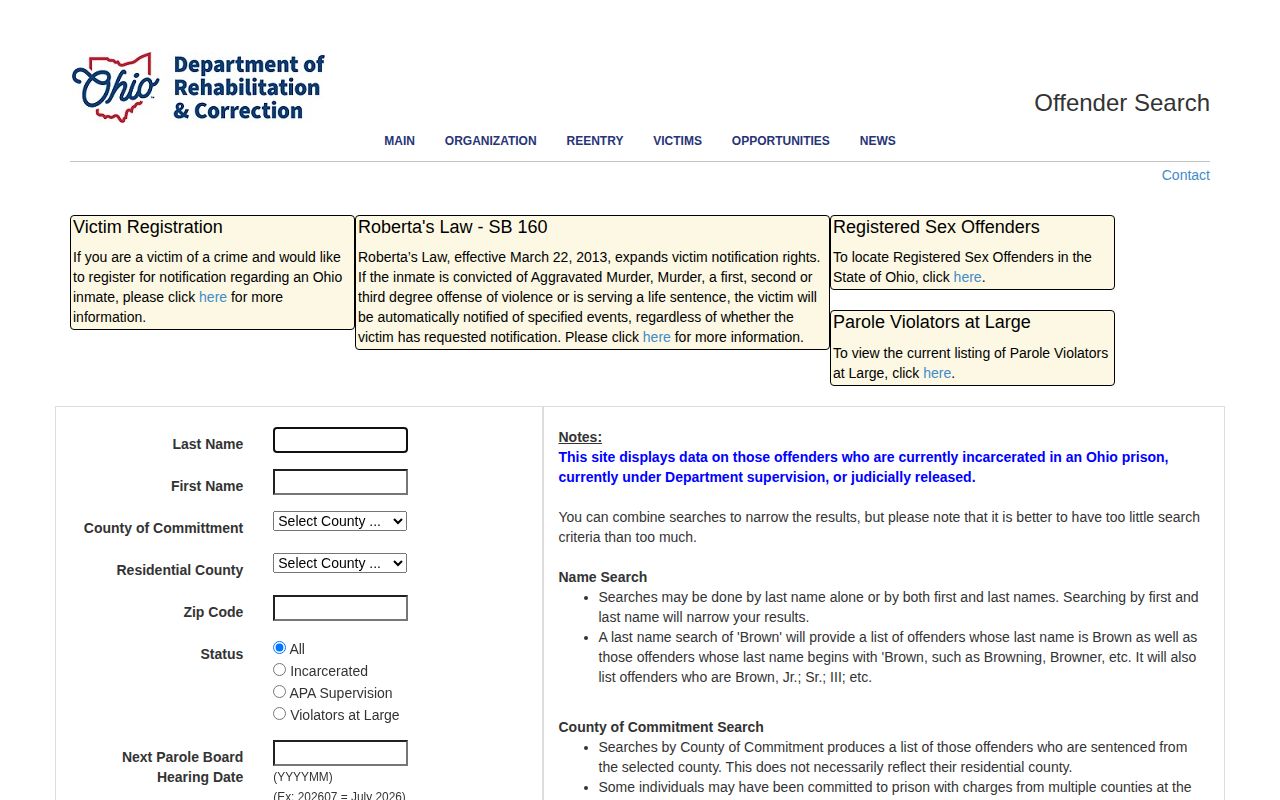
The screen supports a focused state-prison search, but each result still needs identity matching and a full detail review.
Note: An address in an ODRC result can be the last recorded address and should not be treated as a verified present location.
ODRC Union County Release Fields
ODRC detail records can carry the offender number, photograph, status, institution or supervision information, admission or effective-sentence data, jail-time credit, offenses, commitment counties, sentence terms, expected release or parole eligibility data, and hearing or review information. Fields vary by sentence and stage. A blank field is not a license to calculate a date from a general rule.
| Field or status | Meaning in the release check |
|---|---|
| Incarcerated | The person is listed in Ohio state-prison custody. |
| Released | A historical release category that should be read with its complete qualifier and dates. |
| APA Supervision | Can include parole, post-release control, and Violators at Large. |
| Judicial Release | The sentencing court shortened prison confinement under statute and conditions. |
| Expected Release Date/Parole Eligibility Date | May be an expected endpoint or only the first point for Board consideration. |
| Parole or Release Detail | Provides event information after a parole or release action. |
A released public example shows how ODRC combines the status qualifier with sentence and release fields. The ODRC judicial-release example is an interface example, not a model for another person’s facts.
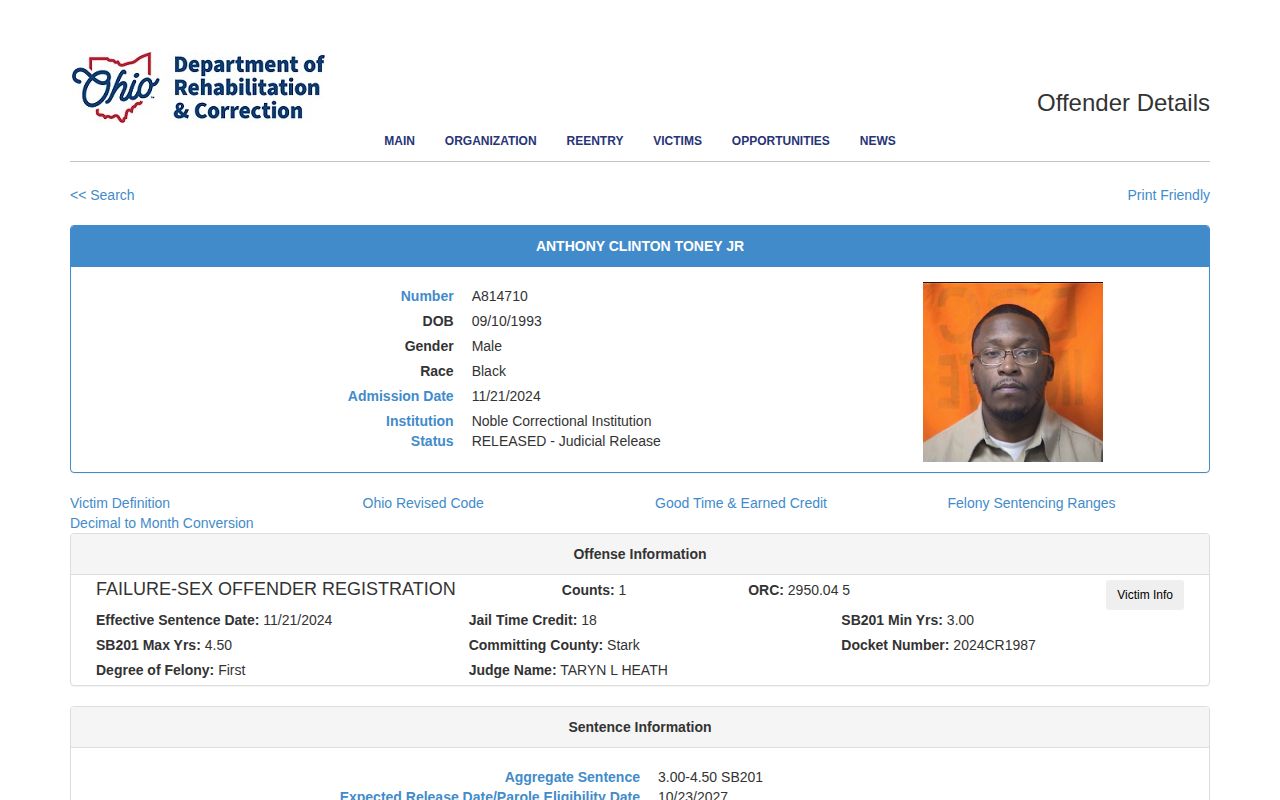
The example reinforces one rule: “released” and “judicial release” must remain together because the qualifier changes the meaning of the event.
ODRC Union County Sentence Dates
The exact public label is “Expected Release Date/Parole Eligibility Date.” A definite-term date and a parole eligibility point are not equivalent. For a parole-eligible sentence, eligibility only opens review. The Ohio Parole Board may grant with conditions or later timing, deny or continue, defer, rescind, or issue another disposition. Physical discharge must be checked after the decision.
Ohio credit rules are statute-specific. R.C. 2967.194 governs the current earned-credit framework for qualifying confinement, subject to eligibility, exclusions, caps, conduct, and Department review. Some ordinary eligible credits have a fifteen-percent aggregate ceiling, but that is not a promise that everyone serves eighty-five percent. Mandatory and excluded terms cannot be reduced by a broad formula.
ODRC starts from the journalized sentence, effective date, jail-time credit, concurrent or consecutive terms, and mandatory parts. A correction, appellate remand, new sentence, credit award or loss, absence, detainer, Board action, or judicial release can change the displayed date. The court judgment and ODRC computation control over a private estimate.
Note: A hold can turn an expected prison release into an immediate transfer, so identify the next custodian before describing community release.
ODRC Union County APA Supervision
The Adult Parole Authority supervises parole and felony post-release control. An ODRC record marked APA Supervision generally indicates that the person has left prison but remains under Department control. The supervision office, release detail, and dates identify the relevant path. “Expiration of Supervision Term” is the outer control date, not the prison exit date. “Supervision End Date/Early Termination” marks an end to control before the scheduled expiration.
Violator at Large is part of the APA status framework. It does not prove that someone is in jail, and it does not make a last address current. Check the live ODRC record and contact the assigned APA unit or law enforcement for official status. A person should not be approached based on a public result.
For Union County routing, the county Adult Court Services page identifies a local APA unit, while the individual ODRC record is the best source for the person-specific office. Court probation is different. Union County Common Pleas Adult Court Services handles felony community control ordered by the court, not state parole.
ODRC Release Records and Access
ODRC maintains more information than the public search displays. R.C. 5120.21 requires an institutional record with entrance or commitment facts, the date, cause, and terms of discharge, condition on leaving, transfers, and applicable death information. The same statute restricts the broader inmate and APA file while allowing disclosure of specified items, including name, convictions, photograph, supervision status, current and past incarceration places, and disciplinary history.
A focused request should identify the DRC number, institution, and date range, then ask for the publicly releasable status, discharge, and transfer fields or other segregable portions. It should not promise access to an entire institutional or supervision file. Ohio public-record law also permits redaction or withholding when a specific exception applies.
Ohio Department of Rehabilitation and Correction
State-prison and APA records for Ohio
Use the DRC number, institution, and date range for a focused Department records inquiry.
For a Union County judicial release, compare the ODRC qualifier with the Common Pleas docket. For a completed state release, the ODRC status and release detail are the online verification path. The Union County released inmate records path explains how to reconcile that state event with prior local custody.
Note: Request releasable fields and segregable records, not a complete ODRC institutional or supervision file that Ohio law restricts.
ODRC and Union County Geography
Union County presents an unusual map. Its adult county detainees are housed at Tri-County Regional Jail in Champaign County, while Union County itself contains Ohio Reformatory for Women, a statewide ODRC prison. West Central Community Correctional Facility and a juvenile center are also located near Marysville but serve different legal populations. Physical location does not establish who committed, supervises, or releases a person.
Three filters must stay separate. “Located in Union County” describes the site. “Serves Union County” describes an operational relationship. “County of Commitment: Union” identifies the court county for an ODRC sentence. A person committed by Union County may serve time elsewhere, while someone at the reformatory may have no Union County case.
This geography also explains why the Tri-County roster cannot verify an ODRC release. The local roster covers current regional-jail custody. ODRC covers state imprisonment, APA supervision, and judicial releases. A transfer between them is a change in custodian, not proof that the person entered the community.
Confirm ODRC Union County Discharge
A sound confirmation uses the full ODRC detail, the controlling court entry when relevant, and the receiving-custodian record if a hold exists. Compare names, date of birth, DRC number, offense, case, commitment county, and event dates. When sources disagree, compare timestamps before choosing a result. A newly ordered judicial release may appear in court before the state completes processing.
VINE can provide a custody-change alert for a participating ODRC record, but it is a downstream notice rather than the signed release instrument. A missed or delayed alert does not prove continued custody. Return to the ODRC record and confirm with the Department after the expected event.
Use precise language. “Not on the Tri-County roster” is a local negative result. “Incarcerated” is ODRC prison custody. “APA Supervision” means outside prison with state control in many cases. “Released to the community” requires release detail that rules out transfer to another authority.