
Union County Projected Release Dates
A projected or expected release date is a calculated point based on the sentence data known to the agency. An actual release date records what occurred after all processing was complete. In Ohio, those values can answer different questions. ODRC uses the combined label “Expected Release Date/Parole Eligibility Date,” so one field can mean an expected endpoint for a definite term or the first date of possible Board consideration for an eligible indefinite or life sentence.
Tri-County Regional Jail does not publish a projected-date calculator. A pretrial detainee’s custody may change through bond, recognizance, dismissal, a court order, or another case. A sentenced jail inmate’s endpoint comes from the journalized term, certified jail-time credit, and any lawfully applicable credit. The court entry and jail records are therefore more useful than a generic percentage estimate.
A hold can turn a scheduled departure into an immediate transfer. In that case, the person left one facility but did not enter the community. Check the receiving agency before describing the event as release.
Find Union County Inmate Release Dates
Start by deciding whether the person is in the regional jail, an Ohio prison, another local jail, or federal custody. The Tri-County current roster is not an ODRC sentence record, and ODRC is not a complete archive of Union County jail stays. Use name, date of birth, booking number, case number, and DRC number to prevent a same-name mismatch.
- Check the Tri-County roster for current local custody. Record its displayed update time. A missing name does not prove release.
- For an Ohio prison sentence, open the ODRC Offender Search. Search by the DRC number when known, or begin with the last name.
- Use County of Commitment as Union only when the sentencing court is known. Do not confuse commitment county with residential county or prison location.
- Open the correct detail and find “Expected Release Date/Parole Eligibility Date.” Read it with the complete status, sentence terms, jail-time credit, and hearing information.
- For a county jail sentence or pretrial case, read the Union County Common Pleas or Marysville Municipal Court docket and contact Tri-County at 937-834-5000.
- When the date arrives, confirm the final event through ODRC or request the jail-register date and manner of discharge required by R.C. 341.02.
The Union County release search and records overview provides the broader custody trail when the person may have moved between Tri-County, ODRC, or another authority. Use that trail before relying on one date from one system.
Note: A court order may authorize release before the jail finishes processing, so compare the order with the later custody record.
ODRC Union County Release Date Field
The ODRC detail is the central public source for a Union County state-prison sentence. It can show the offender number, complete status, institution or supervision data, effective sentence information, jail-time credit, offenses, counties, and parole or release details. It may also show hearing or review information. Each record differs, so a blank field should not be replaced with a guessed date. The ODRC public detail example demonstrates the combined expected-release and parole-eligibility label used by the state.
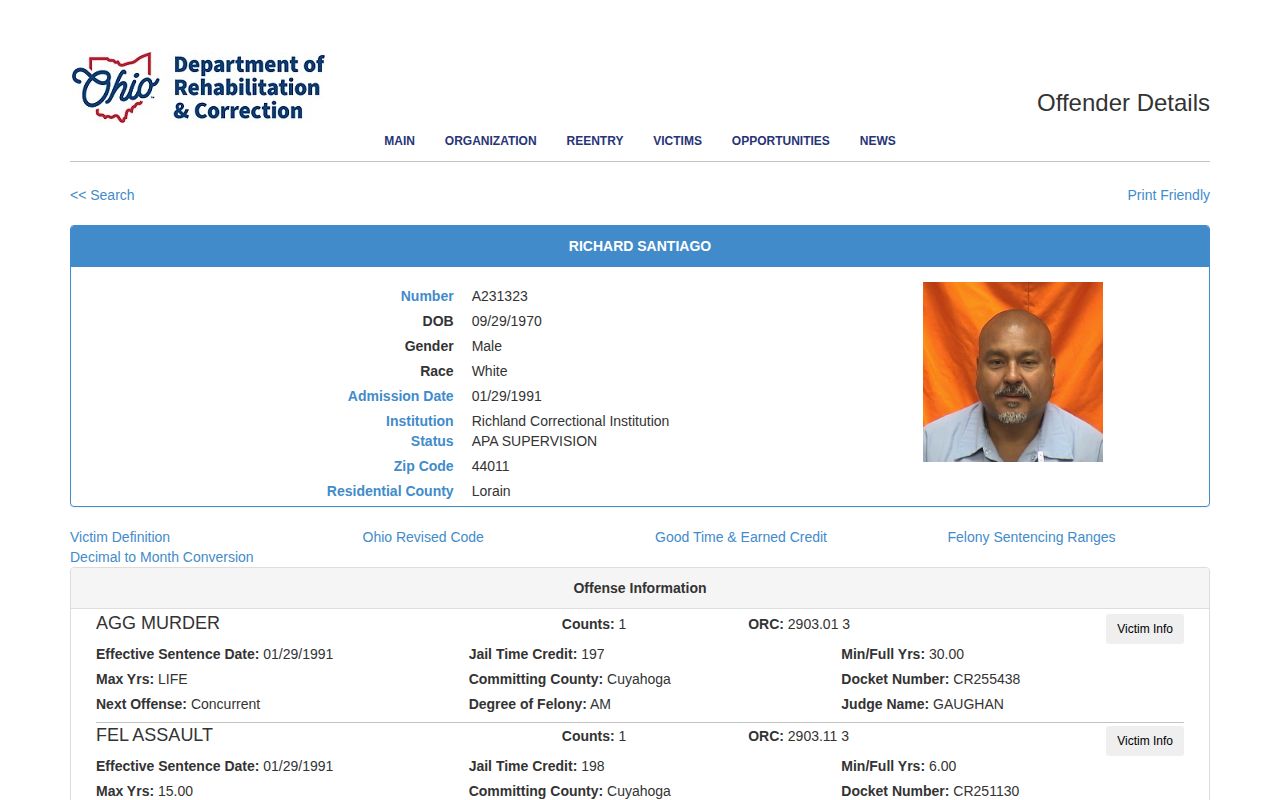
The example illustrates where to look, not how to calculate a different person’s sentence. Match the DRC number, offense, county, sentence terms, and status on the actual record.
| ODRC field | How to read it |
|---|---|
| Expected Release Date/Parole Eligibility Date | May be an expected definite-term endpoint or only an eligibility point for Board review. |
| POA Date | The earliest parole-on-or-after date for release to APA supervision. |
| PRD | Projected release date in ODRC terminology. |
| Next hearing or review month | A Board scheduling field, not a promise of release. |
| Expiration of Supervision Term | The outer APA supervision date, not the prison exit date. |
| Supervision End Date/Early Termination | The end of supervision, which occurs after or apart from prison release. |
ODRC also uses complete status qualifiers. Judicial release means the sentencing court shortened prison confinement subject to law and conditions. APA Supervision generally means the person is outside prison but remains under parole or post-release control. Incarcerated means state-prison custody. These qualifiers should be read with the date rather than reduced to a simple “out” or “in” label.
Ohio Union County Sentence Calculations
An Ohio release calculation begins with the journalized sentence and effective sentence date. Jail-time credit is then applied as ordered or certified under R.C. 2967.191. Concurrent terms run together to the extent the judgment allows, while consecutive terms run one after another. Mandatory or nonreducible parts must stay in the calculation. Only then can a lawful earned-credit provision affect the expected endpoint.
Definite and indefinite terms also differ. R.C. 2929.14 and 2929.144 govern important sentence components, while R.C. 2967.271 addresses Ohio’s non-life indefinite release framework. A life or other parole-eligible sentence is governed in part by R.C. 2967.13. Its eligibility point opens the door to review; it does not require the Board to grant parole.
Other lawful paths can change the form or place of custody. R.C. 2929.20 covers judicial release. R.C. 2967.26 covers transitional control, which can move an eligible person to closely monitored community confinement before expiration. That can include a halfway house or approved residence with monitoring. It is not an unconditional discharge.
ODRC’s sentence computation and the controlling court judgment take priority over a web estimate. When the two appear to conflict, compare the effective sentence date, credit, concurrent or consecutive structure, and later journal entries. A corrected sentence or appellate action may explain the difference.
Union County Release Date Credits
Ohio does not use a single rule that promises every state prisoner release after serving 85 percent. For qualifying confinement on or after April 4, 2024, R.C. 2967.194 provides the current earned-credit framework. R.C. 2967.193 is the predecessor. Eligibility depends on the sentence, offense, conduct, approved activity, and ODRC review.
Under the current framework, an eligible person may provisionally earn one or five days per completed month of productive participation in approved education, vocational training, prison industries, treatment, or another constructive activity. Completing a second qualifying activity can add up to five days. Certain eligible people outside listed mandatory, violence, and sexually oriented offense terms may qualify for other stated completion credits.
The ordinary aggregate credit governed by the statute has a fifteen-percent stated-term ceiling. That ceiling is not a guarantee. Credits remain subject to Department review and can be denied or withdrawn for rule violations. Statutory exclusions include various mandatory or nonreducible terms, aggravated murder and murder categories, death or life-without-parole sentences, covered Chapter 2971 terms, specified sexually oriented offense terms, and other listed cases.
Jail-time credit and earned credit are also different. Jail-time credit accounts for qualifying confinement already served before or during sentencing. Earned credit rewards approved participation during eligible ODRC confinement. Neither should be applied by a simple online calculator without the judgment and current ODRC sentence data.
Why Union County Release Dates Change
A projected date can move because the inputs or legal status change. Some events shorten the projected term, while others add time, pause release, or change a community departure into a transfer. The reason should be traced to an ODRC update, Board action, court entry, or receiving-custodian record.
| Factor | Possible effect on release | Best record to check |
|---|---|---|
| Jail-time credit correction | Changes credited days and the computed endpoint | Sentencing entry and ODRC detail |
| Earned-credit award or loss | May move an eligible expected date earlier or later | ODRC sentence computation and current detail |
| Additional or corrected sentence | Can alter concurrent, consecutive, mandatory, or maximum terms | Court judgment and later journal entries |
| Appeal or remand | May require a new or corrected sentence | Appellate mandate and trial-court docket |
| Hold or detainer | Can cause transfer to another authority on the scheduled date | Release or transfer sheet and receiving agency |
| Parole Board action | May grant, deny, defer, continue, or rescind a planned release | Published Board action and later ODRC status |
| Judicial release | Can shorten prison confinement under a court order | Common Pleas judgment and ODRC qualifier |
Escape or another period of absence can affect sentence computation as well. The public page may lag behind a newly journalized action. Use timestamps and identifiers when records disagree, and report the narrowest fact the sources establish.
Note: A favorable parole decision can include conditions and later timing; the vote alone does not prove physical discharge.
Tri-County Release Date Limits
No verified public Tri-County good-time policy or weekend-release rule was found in the official materials reviewed for Union County. That gap matters. A local jail term should not be calculated with the ODRC prison-credit framework, and no assumed weekend adjustment should be added. Use the sentencing entry, certified credit, and jail record instead.
A pretrial detainee has no set release date because the case can change through bond, dismissal, plea, sentencing, or another order. Even after bond is posted, jail processing takes time. The current Tri-County roster refreshes on a nominal thirty-minute cycle, but that is only the web update pace. It is not a release schedule and does not prove the hour someone left.
For a sentenced jail term, ask the court for the journal entry and Tri-County for the associated custody record. If the person disappears from the roster, request the date and manner of discharge. The manner distinguishes community release from transfer to ODRC, another jail, BOP, USMS, or ICE.
This local constraint is the key reason a universal calculator fails in Union County. Jail, definite prison, indefinite or life, parole-eligible, and judicial-release cases all follow different paths. The label on the source record tells which path applies.
Union County Parole Eligibility Dates
Parole eligibility is not the same as a projected physical release date. The Ohio Parole Board reviews parole-eligible terms, and ODRC allows a search by next hearing month. An individual detail may show an eligibility date or hearing/review month. Those values mark a legal or administrative stage, not a guaranteed exit.
Published Board outcomes should be described in their own terms. A matter can be granted with conditions or effective timing, denied or continued, deferred, rescinded, or assigned another disposition. After any Board action, check the ODRC status and release detail. A detainer may still send the person to another custodian.
People serving modern definite non-life terms may leave through sentence expiration and post-release-control rules rather than discretionary parole. That is why the combined field label requires the sentence type. The same words on the screen can serve different functions in different records.
Confirm Union County Actual Release
A pending date can be monitored through Ohio VINE when the correct local jail or ODRC record participates. Register on the specific person’s record and select the offered custody-change or release event. Alerts can be delayed because of agency feeds, carriers, transfer timing, or contact details. They support planning but do not replace direct confirmation.
The Union County VINELink release check explains how to choose the correct agency and register for the available notification channels. For Tri-County custody, use the regional jail record rather than a fictitious standalone Union County jail. For state prison custody, use the ODRC contributor.
After the projected day, verify the final status with the releasing office. A local jail-register entry must include the date and manner of discharge under R.C. 341.02. ODRC’s completed release or supervision detail serves the state-prison path. If another agency took custody, its locator or record completes the chain.
The safest wording matches the proof. “Expected release date” is a forecast. “Eligible for parole” marks possible review. “Left Tri-County” states only a custodian change until the manner is known. “Released to the community” requires a record showing that outcome.
Note: Call the releasing agency before travel because no verified public release hour, exit door, or waiting location is available.