
Federal Bureau Release Paths
The Federal Bureau of Prisons, or BOP, holds people serving federal sentences in institutions across the country. It is a national system, not a physical Union County facility. Its relevance begins when the person was convicted in federal court. A local arrest alone does not place someone in BOP custody. The person may have been held first by the U.S. Marshals Service in a contract jail and only later transferred to BOP after sentencing.
A sentenced person can leave a BOP institution through release at the end of federal imprisonment or another authorized federal placement or custody change. The locator may then show a release date and a location value of “RELEASED.” That establishes departure from BOP custody. It does not establish that all federal supervision ended, nor does it exclude state, local, or immigration custody. Federal supervised release is overseen by U.S. Probation under the sentencing court, not by the Ohio Adult Parole Authority.
If a Union County booking closed because the person entered federal custody, the local discharge entry should name the receiving custodian or manner of discharge. Request that entry through the Union County Sheriff public-record channels. That local transfer is not a community release. Pair it with the federal record to follow the handoff.
Confirm Federal Bureau Releases
The BOP Inmate Locator is the main public search for sentenced federal prisoners. Search by a federal identifier when possible because common names can produce several matches. Available number searches include BOP register, DCDC, FBI, and INS numbers. A name search can use first, middle, and last name with age, race, or sex to narrow the result.
- Open the BOP locator and choose number search when a verified federal identifier is available.
- Otherwise, enter the legal name and add only reliable identity fields.
- Compare the name, register number, age, race, and sex across possible matches.
- Read the release date and location together. Do not stop at one status phrase.
- Check the federal docket or U.S. Probation when supervision or a court order remains relevant.
- Search the receiving custodian if another agency may have assumed custody.
The wider Union County released inmate search explains how to reconcile the local jail entry with court, state, and federal records when custody crossed systems.
Federal Bureau Locator Fields
A result returns a compact field set. It is valuable because it ties the identity to a federal register number and gives the BOP custody position. Yet it is not a full sentence file. The exact federal court docket and later supervision records can answer questions that the locator does not.
| Locator field | How to read it |
|---|---|
| Name and register number | Primary match fields for the federal record. |
| Age, race, and sex | Supporting identifiers used to separate similar names. |
| Release date | The BOP date shown for release; it can change after recalculation or applicable credits. |
| Location | The current BOP institution or “RELEASED” when the person is no longer in BOP custody. |
| UNKNOWN date | BOP has not determined the term endpoint shown by the locator. |
The official locator system is the verified contact and search route documented for this national system.
Coverage: federal inmates from 1982 to the present, with a National Archives route for older records
Search: name or register/DCDC/FBI/INS number
Result use: confirm BOP custody or release status, then reconcile other custody and supervision
The official BOP interface shows the public search choices and result structure.
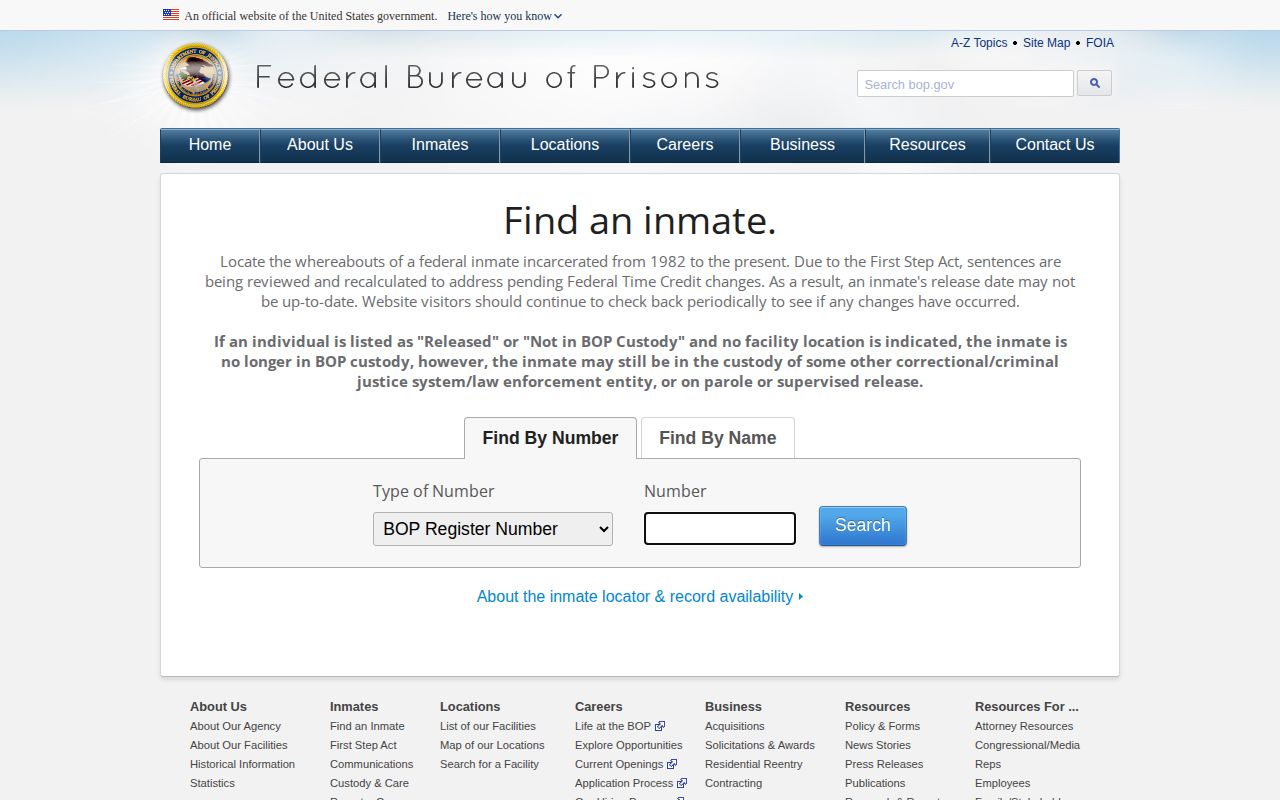
The image belongs to the national locator. It does not depict a jail located in Union County.
BOP Release Status Limits
“RELEASED” means the person is no longer in BOP custody. It does not prove an unconditional return to the community. The person could be under federal supervised release, held by a state or local authority, or affected by immigration custody. The federal judgment and U.S. Probation records control the supervision question. Ohio APA handles Ohio parole and post-release control, not federal supervised release.
“Not in BOP custody” is even narrower. It states only that BOP is not the present custodian. It can cover a released person, someone held by another sovereign, or a person whose federal custody status belongs elsewhere. Likewise, a blank search can reflect a name mismatch, a record outside the locator's scope, or a pretrial matter rather than release.
Dates may change with sentence recalculation and applicable credits. An “UNKNOWN” date means BOP has not determined the displayed endpoint. It should not be converted into an estimate.
Union County Federal Release Systems
A federal custody search should not begin with whichever locator happens to be familiar. The case type and custody stage choose the system. Tri-County covers current regional jail custody. ODRC covers Ohio state prison custody and state supervision. BOP covers sentenced federal prisoners. U.S. Marshals custody often covers the federal pretrial stage. ICE covers civil immigration detention. Moving from one source to another can reflect transfer rather than release.
| Source | Population and proof |
|---|---|
| Tri-County roster and register | Current local custody plus the local date and manner of discharge. |
| BOP locator | Sentenced federal prisoners and the displayed federal release date or custody location. |
| U.S. Marshals and federal court | Federal pretrial custody, detention orders, and release orders. |
| U.S. Probation | Federal supervised release under the sentencing court after prison. |
| ODRC and Ohio APA | Ohio prison and state supervision only, not a federal sentence. |
For a person first held at Tri-County, request the date and manner of discharge required by Ohio law. If the manner says delivery to a federal agency, that closes the local stage but confirms continued custody. Next, determine whether the person was a pretrial Marshals detainee or a sentenced BOP prisoner. The federal docket can bridge those stages by showing detention, plea, sentencing, commitment, and release orders.
A release date in the BOP result should also be compared with the docket. The locator can establish that BOP custody ended, while the judgment can show whether a term of federal supervised release followed. Do not translate that federal term into parole or Ohio post-release control. Different law, courts, and agencies govern it.
Union County Federal Pretrial Custody
Pretrial federal detainees are generally in U.S. Marshals custody, even when they sleep in a local or contract jail. That is why the BOP locator can fail for a person with an active federal case. The Marshals public material is not a complete historical locator like BOP's. Location questions should be traced through the arresting federal district, the court, and the detention custodian.
Search the relevant federal docket for a detention order, release order, plea, sentencing entry, or commitment. A court order can authorize release before physical processing is complete. Confirm the actual custody change with the facility or agency holding the person. Once sentenced and received by BOP, the national locator becomes the stronger public route.
The U.S. Marshals prisoner guidance explains that distinct pretrial role. A Tri-County disappearance after a federal pickup should be described as departure from the local jail until the receiving federal custodian is verified.
Older Federal Release Records
The BOP locator covers federal inmates from 1982 forward and certain older records. For a former federal prisoner whose custody predates that period, follow the National Archives path provided by BOP. Do not infer that no federal confinement occurred merely because the current locator returns no match. Older names, identifiers, and archival coverage can differ.
Begin with the full legal name, approximate confinement years, federal court, and any register number found in the docket. Those details help distinguish an archival request from a search for a current prisoner. A historical release date documents the end of BOP custody for that term. It does not establish whether another sentence, custody event, or supervision period followed.
Union County Federal Custody Geography
Union County's regional jail explanation helps separate three different ideas: a facility located in the county, a system serving a person arrested there, and a sentence imposed by a court with a Union County connection. BOP institutions are nationwide. The federal system is relevant because a federal prosecution can lead to federal custody, not because a BOP prison is located in Union County.
That differs from the local and state geography. Union County adults in county-jail custody are housed at Tri-County Regional Jail in Champaign County. Ohio Reformatory for Women is physically in Marysville but belongs to ODRC and serves a statewide population. A person may therefore be arrested in Union County, held regionally, prosecuted federally, and imprisoned in another state without any contradiction.
Custody records should follow the operator. Use Tri-County for the local jail event, U.S. Marshals for federal pretrial custody, BOP for the sentenced federal term, and the federal court for supervision. Each source proves only its own stage.