
Union County Parole and Probation
Parole, post-release control, and probation are separate forms of supervision. Parole is release from a parole-eligible prison term under the authority of the Ohio Adult Parole Authority, or APA. Post-release control is a period of APA supervision that follows certain Ohio prison terms. Probation, often called community control in a felony case, is ordered by a court and can be imposed instead of prison or after a local jail term. The source of the sentence identifies the right office.
A person released from Tri-County Regional Jail is not automatically on probation. The discharge may have resulted from bond, time served, dismissal, transfer, or a sentence with no further control. Likewise, an ODRC result marked released does not by itself explain whether supervision continues. Read the full qualifier, the supervision fields, and the court judgment. These details prevent a jail departure from being mislabeled as parole.
| Type | Who orders it | Union County verification route |
|---|---|---|
| Parole | Ohio Parole Board for an eligible state sentence | ODRC Offender Search, published Board material, and the assigned APA unit |
| Post-release control | Applies under Ohio sentencing law after certain prison terms | ODRC APA Supervision status and the person-specific supervision detail |
| Felony probation or community control | Union County Common Pleas Court | Common Pleas docket and Union County Adult Court Services |
| Misdemeanor probation | Marysville Municipal Court | Municipal docket and the court probation office |
- Discharge
- The formal end of custody or supervision, as shown by the responsible agency or court.
- Absconder
- A supervised person reported as having left supervision without authorization. It is not proof of current jail custody.
- Capias
- A court order directing that a person be brought before the court.
- Detainer
- A request or hold from another authority that can lead to transfer instead of community release.
Verify Union County Release Supervision
Begin with identity, not a broad status label. Full name, date of birth, court case number, and DRC number help separate people with similar names. A Union County conviction can place someone in an ODRC institution anywhere in Ohio, while a person supervised in Union County may have been committed by another court. County of commitment and residential county answer different questions in the state search.
- Check the ODRC Offender Search. Use the DRC number when known, or start with a last name and add only enough detail to identify the correct record.
- Run the APA Supervision status view. Also inspect Released and Violators at Large when the first search does not explain the present record.
- Open the detail and compare the offense, commitment county, status qualifier, supervision office, and relevant dates. A last recorded address is not proof of a current location.
- Search the Union County Common Pleas docket for community control, judicial release, violation, termination, or satisfaction entries when the sentence is a felony court matter.
- For a misdemeanor, use Marysville Municipal Court and give its probation office the full name and case number in a written inquiry.
- Confirm an uncertain result with the assigned APA unit or court office. Public search fields do not replace the controlling court order or agency discharge record.
The Union County released inmate search and record path helps establish whether the person left Tri-County, entered ODRC, or moved to another custodian before the supervision inquiry begins. That custody path matters because a local roster absence alone says nothing about parole or probation.
ODRC Union County Parole Search
ODRC provides the strongest public online route for state parole and post-release control. Its search covers people in Ohio prisons, under Department supervision, or judicially released. Status filters include Incarcerated, Released, APA Supervision, and Violators at Large. Individual records can show a DRC number, photograph, offenses, counties, prison or supervision information, expected release or parole eligibility data, and hearing or review information. Field availability varies by sentence and status.
The public results interface also allows a next Parole Board hearing month search. The ODRC supervision and hearing results interface shows how release, APA, and hearing-month filters fit into one search path.
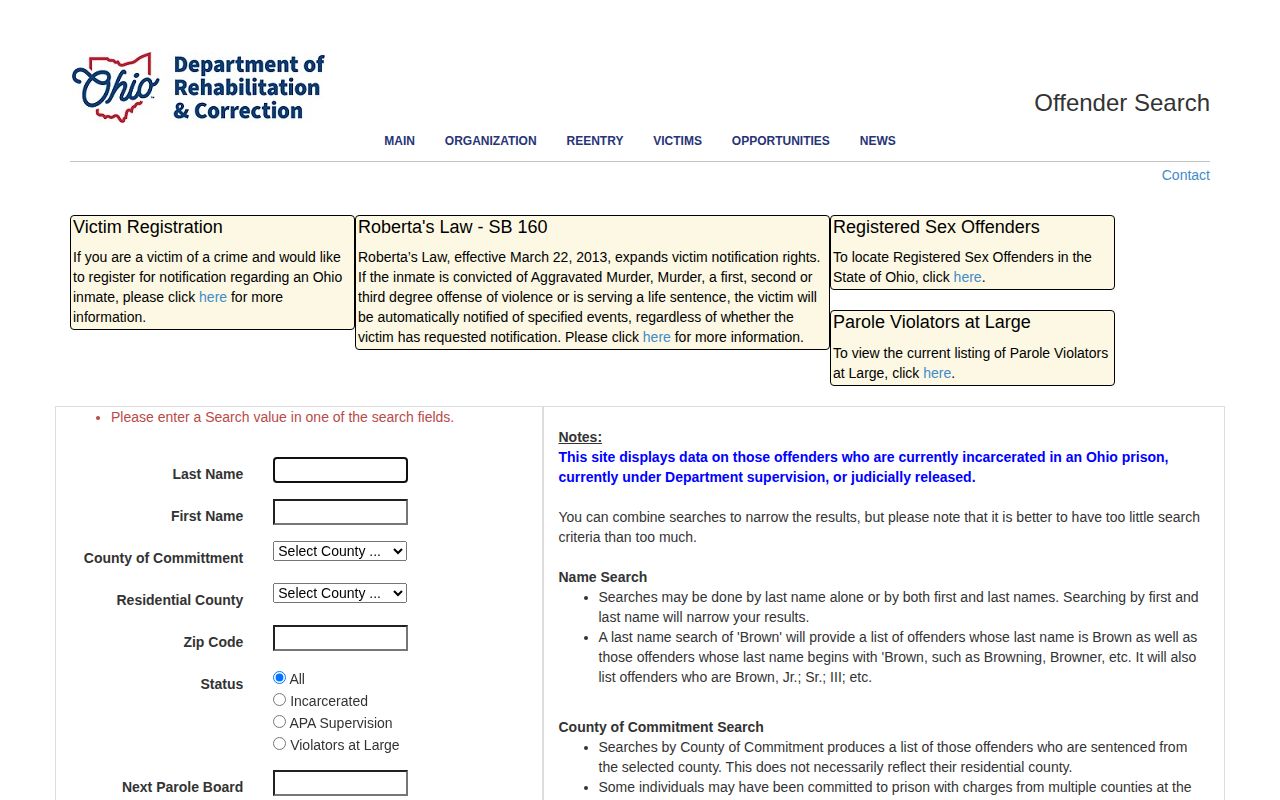
This screen is useful for narrowing a search, but a result must still be opened and matched to the correct person. “Released,” “APA Supervision,” and a hearing date describe different stages. None should be substituted for another.
ODRC warns that residential information can be the last recorded information and that updates can lag. A complete qualifier such as judicial release carries more meaning than the single word released. If the public fields conflict with a court entry, compare dates and identifiers, then ask ODRC or the court for the releasable record that controls.
Note: A supervision period may arise from a prior offense, so compare each sentence and case before drawing a conclusion.
Union County Probation Office Routes
Union County’s local arrangement is unusually clear because felony Adult Court Services and the local APA function appear on the same county supervision page while remaining legally distinct. The correct route rests on the court and sentence. Common Pleas Adult Court Services handles adult felony community control. The APA Union County Unit serves felony post-release-control matters. Marysville Municipal Court handles misdemeanor probation.
The official Union County Adult Court Services page supplies the current local contacts and should be checked before a visit or call because staff assignments can change.
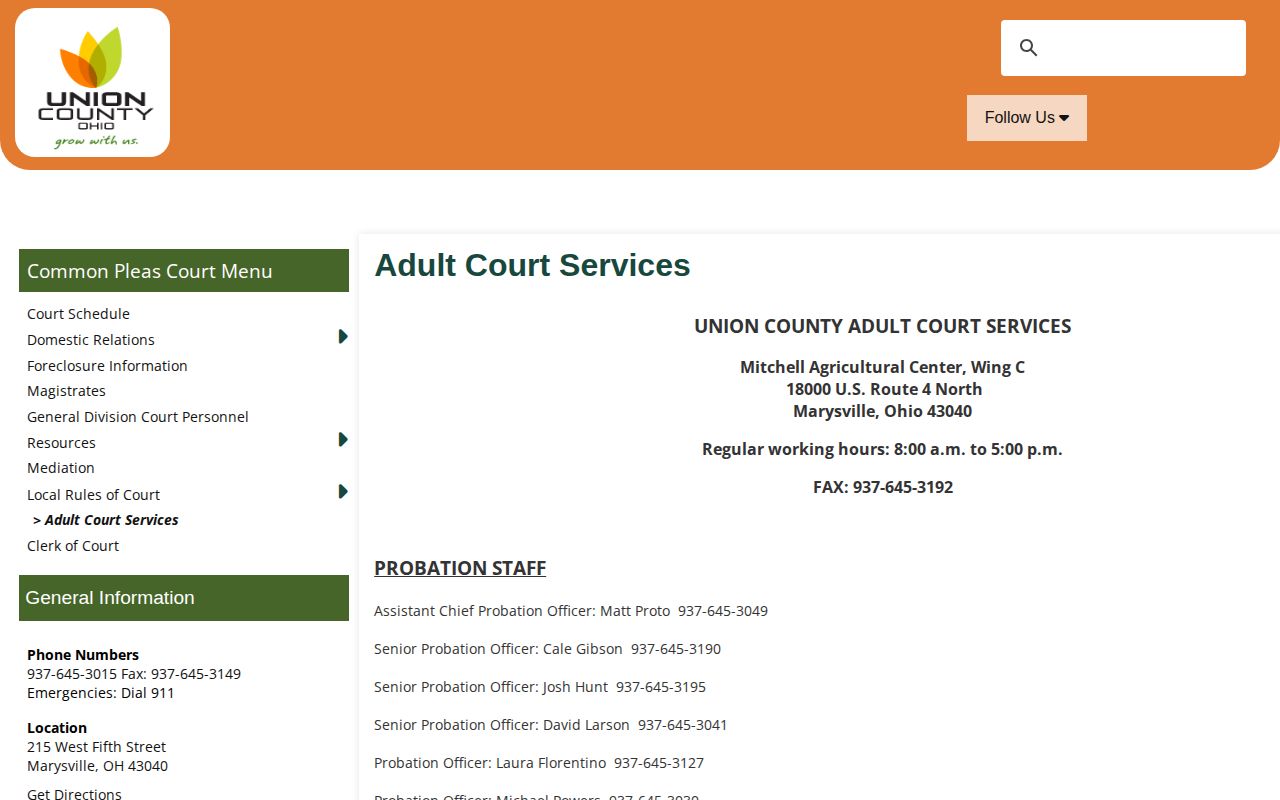
The county page separates APA from court probation, which helps route a case without guessing from the fact of release alone.
Adult Court Services and APA Unit
Mitchell Agricultural Center, Wing C
18000 U.S. Route 4 North
Marysville, OH 43040
Hours: 8:00 a.m. to 5:00 p.m.
APA Union County Unit: 937-645-3194
Marysville Municipal Court Probation
1250 West Fifth Street
Marysville, OH 43040
937-644-9102, option 3
Email: probation@marysvilleohio.org
Fax: 937-644-2768
For an ODRC case, the office shown in the individual offender detail is the best person-specific route. For Municipal Court probation, the court asks that routine messages be in writing and include the person’s full name and case number. A public contact should be used to confirm the responsible unit, not to infer facts about a person from an address alone.
Union County Supervision Violations
Supervision conditions come from the court order, release document, and supervising authority. They can include reporting, approved travel, treatment, payment, or other case-specific duties. A public search does not show the full case file, and Ohio law does not make all probation or parole proceeding material open. R.C. 149.43 excludes specified supervision records, while published ODRC fields and certain Parole Board determinations, orders, minutes, and notices remain the safer public route.
“Violator at Large” means ODRC has recorded an APA-supervised person as at large or absconded. It does not prove that person is in a jail, and the last address should not be treated as a live location. Check the current ODRC result and contact APA or law enforcement for official status. Do not approach a person based on a locator entry.
Municipal Court gives a different example. Its probation information states that a violation notice requires a personal appearance and that failure to appear can lead to a capias. The notice or capias is a court-enforcement event. It does not prove an arrest has occurred. Current custody must be checked with the actual jail or receiving agency.
Note: VINE tracks custody events supplied by participating agencies, not every change in probation or parole conditions.
Union County Parole Hearing Records
The Ohio Parole Board decides release for parole-eligible sentences. ODRC’s locator can search by the next hearing month and an individual detail can show a hearing or review month. The Board also publishes hearing materials, calendars, minutes, and decision information through its current site structure. Those documents change by month, so use the current published material rather than an old saved calendar.
A parole-eligibility date is the first date when a person may be considered under the governing law. It is not a grant. R.C. 2967.13 sets key eligibility rules for life and other parole-eligible terms, and different sentence dates and offenses produce different treatment. A Board outcome may be granted with later conditions or timing, denied or continued, deferred, rescinded, or recorded in another form. Always use the decision’s own wording.
Even a favorable vote does not confirm physical release from prison. ODRC must process the event, and a hold can result in transfer to another authority. Check the offender’s updated status, parole or release detail, and the receiving custodian if one is named. Published decisions and minutes may answer the Board question, while the later ODRC event answers the custody question.
Union County Recovery Court Supervision
Union County Adult Court Services identifies FSTR Recovery Court as a certified Common Pleas specialized docket. It combines treatment with intensive supervision for accepted felony participants. This local program is part of the county’s post-release and community-control landscape, but participation cannot be inferred from a charge, a jail stay, or a person’s release.
Use the Common Pleas docket to confirm that the court placed a named person in the program. Program questions can then go to Adult Court Services. At the research date, the county listed the Director of Specialized Dockets at 937-645-3033 and a case manager at 937-645-3455. Roles can change, so the live county contact page remains the source for current routing.
This distinction protects the meaning of the record. Recovery Court is not parole, and it does not establish that a person served an ODRC prison term. It is a court-based supervision and treatment track for accepted participants. The journal entry, not a broad label, confirms the legal status.
Property After Union County Release
Supervision may begin after a person leaves Tri-County, but the jail’s release process has a separate local detail. The Tri-County inmate handbook says property is collected and secured at admission. At release, the resident signs a property inventory. That signed record can help document what was returned without being confused with a probation or parole discharge.
If someone transfers to a facility that will not accept the property, the handbook says the resident designates another person to pick it up. After contact, the property may be held for up to seven days before possible destruction or donation. This rule is important when a jail departure is actually a transfer to ODRC or another custodian, since the person may not be free to collect items.
Property questions belong with Tri-County Regional Jail at 937-834-5000. Questions about reporting after release belong with the assigned APA or probation office. Keeping those channels separate avoids asking court staff to resolve a jail inventory issue or asking jail staff to interpret supervision terms.
Note: Call Tri-County before arranging pickup because the public materials do not give a verified release exit, waiting area, or pickup schedule.
Ending Union County Release Supervision
Supervision ends through the authority that imposed or administers it. A court can terminate felony or misdemeanor probation and place the action in its docket. ODRC can show the expiration of a supervision term or an early termination in the offender detail. Those dates are not the same as the date a person first left prison or jail.
A clean verification uses two points. First, identify the type of supervision and office. Second, obtain the ending entry from that system. For probation, look for termination, satisfaction, revocation, or another journalized disposition. For APA supervision, read the complete ODRC status and supervision end field, then ask the assigned unit about any unclear public value.
Discharge from supervision means the formal control has ended. It does not erase the underlying court or custody record. Ohio access rules can also protect parts of a supervision file even when a public status is visible. A focused request for a published determination or releasable discharge field is more accurate than asking for an entire parole or probation case file.